Leave-In Conditioner vs Hair Oil: What Dry Hair Actually Needs
Your hair can feel rough after washing even when your roots look clean. Or it can feel soft in the shower, then become difficult to comb or untidy at the ends once it dries. At that point, the choice between a leave-in conditioner and a hair oil can feel surprisingly unclear.
Both may have a place in a routine for dry-looking hair. They are different product types, though, and choosing one starts with what you want your next step to do.
A leave-in conditioner is generally the more useful starting point for extra conditioning and manageability after washing. A hair oil is often a finishing option for softness, shine and the appearance of dry ends.
Depending on the formulas and your hair, you may prefer one, both or neither.
You do not need a long routine. You need a few steps that each have a clear purpose.
A quick comparison
Question
Leave-in conditioner
Hair oil
What is it?
A conditioning formula designed to remain in the hair
An oil-based product or oil-containing blend; formulas vary
Typical reason to use it
Easier handling, less tangled-feeling hair, a softer finish
Added shine, softness and a more polished appearance at the ends
Common application
Often on damp hair after washing, according to the label
On damp or dry lengths and ends, if the label allows
Does it replace rinse-out conditioner?
Do not assume so; follow the product's intended routine
It is not an equivalent replacement
Can it feel heavy?
Yes, depending on formula, amount and placement
Yes, depending on formula, amount and placement
Is it automatically a heat protectant?
No
No
|
Question |
Leave-in conditioner |
Hair oil |
|
What is it? |
A conditioning formula designed to remain in the hair |
An oil-based product or oil-containing blend; formulas vary |
|
Typical reason to use it |
Easier handling, less tangled-feeling hair, a softer finish |
Added shine, softness and a more polished appearance at the ends |
|
Common application |
Often on damp hair after washing, according to the label |
On damp or dry lengths and ends, if the label allows |
|
Does it replace rinse-out conditioner? |
Do not assume so; follow the product's intended routine |
It is not an equivalent replacement |
|
Can it feel heavy? |
Yes, depending on formula, amount and placement |
Yes, depending on formula, amount and placement |
|
Is it automatically a heat protectant? |
No |
No |
The name on the bottle gives you a category, not a complete prediction of the result. A fine mist and a rich leave-in cream can feel very different. So can two oils with different blends and recommended uses.
Start with the problem you notice
Try to describe your hair without relying only on the word “dry.” That word can cover several experiences that call for different adjustments.
“My hair is difficult to detangle after washing.” Look first at your rinse-out conditioning step. If that is appropriate but you still want easier handling, a purpose-made leave-in may be useful. The American Academy of Dermatology describes leave-in conditioner as an option for improving manageability, including reducing tangles and frizz.[1]
“My hair feels reasonably soft, but the ends look dull.” A small finishing application of hair oil may be enough. Start only where you want a change rather than coating the entire length automatically.
“My roots look oily but my ends feel rough.” Treat these as separate zones. Adding more product at the roots is unlikely to solve the ends' needs. Our guide to balancing oily roots and dry ends explains how to think about that combination.
“Every extra product makes my hair look flat.” Before buying another formula, check how much you use, how close to the roots you apply it and how many finishing products overlap.
What a leave-in conditioner can contribute
A leave-in gives you an additional conditioning step without another rinse. Depending on the formula, it may help hair feel smoother, easier to arrange or less rough between wash days.
Think about the format as well as the headline ingredients. Someone with fine hair might find a light spray easier to distribute sparingly. Someone with denser or coarser lengths might prefer a cream that is easier to work through sections. Neither format guarantees suitability; the useful test is the finished result on your own hair.
Choose a product specifically labelled as a leave-in. Rinse-out conditioner is designed for a different use, and leaving it in or diluting it does not automatically turn it into a suitable leave-in formula.[1]
Luxivie's shampoo and conditioner sets include rinse-out conditioners. They should not be described or used as leave-in products unless current packaging explicitly says otherwise.
What a hair oil can contribute
Hair oil can be a helpful finishing step when you want the lengths or ends to look smoother and shinier. It can also change how the hair feels to the touch. The result depends on the blend, the amount and where you apply it.
Avoid treating “oil” as a promise of deep hydration or permanent repair. An oil-only formula does not supply water, and the word “nourishing” on a cosmetic product is not a guarantee that it can rebuild damaged hair.
Similarly, “natural” does not tell you how light the formula will feel. A botanical oil can still be more than your hair needs, especially when layered over a rich conditioner and several styling products.
For this guide, oil means a cosmetic step for lengths and ends. It does not mean a scalp treatment or a product intended to change hair growth.
Do you need one or both?
If you want to keep the routine simple, add the step that addresses your most noticeable problem first.
|
What you notice |
A sensible first experiment |
|
Tangled-feeling lengths after washing |
Review rinse-out conditioning, then try an appropriate leave-in if needed |
|
Soft hair with dull-looking ends |
Try a small amount of finishing oil on the ends |
|
Rough lengths and dull ends |
Establish a conditioning routine first; consider oil afterwards if the ends still need it |
|
Flat hair after styling |
Reduce overlapping products and review placement before adding anything |
|
Different needs at the roots and ends |
Choose products and application zones separately |
These are starting points, not a diagnosis of your hair or a rule that everyone needs two extra products.
If your existing conditioner leaves your hair easy to handle and you like the finish, you may not need either addition. A routine that works does not become better simply because it has more steps.
How to use them together
For products intended as a post-wash leave-in and a finishing oil, this is a practical sequence. Always let the individual labels override general advice.
- Wash and condition as usual. Choose the wash routine for your actual hair needs, not for the ingredient trend you most recently saw.
- Remove excess water gently. Keep handling comfortable and avoid making tangles worse through vigorous rubbing.
- Apply the leave-in where needed. Start with the label's guidance and distribute it evenly through the intended areas.
- Use any required styling protection. If you use heat, choose a product explicitly labelled for heat protection. Neither oil nor leave-in conditioner automatically provides it.[1]
- Assess the finish. If your chosen oil allows use on dry hair, wait until you can see what the ends actually need before adding it.
- Apply oil sparingly to the target area. Spread it between your hands and distribute it lightly rather than depositing a large amount in one spot.
Some oils are designed for pre-wash use or have different directions. “Leave-in first, oil second” is therefore a useful post-wash example, not a universal rule for every oil product.
Adjust the routine to the hair you have
Fine or easily flattened hair
Focus on the last part of the lengths rather than assuming every strand needs another coating. Test one new product at a time. A routine can leave the ends soft while still being too much for the overall look you want.
If you regularly use a smoothing cream, oil, shine spray and leave-in together, try removing one optional finishing step. This makes it easier to discover what is helping and what is simply overlapping.
If your main concern is choosing the rinse-out step, read how to choose a lightweight conditioner for oily hair.
Wavy, curly or coily hair
Texture alone does not decide how much oil or conditioner you need. Consider density, strand thickness, length, styling preferences and how your hair feels after it dries.
Working in sections can make your own comparison more consistent. Notice whether the product gives the softness and finish you want without leaving parts of the hair overloaded. Do not assume that every curl pattern needs a heavy oil, or that a lighter formula is necessarily inadequate.
Colour-treated or frequently heat-styled hair
Look for directions and suitability statements on the actual products. The presence of an oil or a familiar conditioning ingredient does not establish colour protection, heat protection or permanent damage repair.
If your ends remain difficult to manage, reconsider the whole routine, including how you style them, rather than continually adding more finishing product. For help interpreting another common ingredient comparison, read biotin vs keratin: the difference.
Troubleshooting: when the result is not quite right
“My ends look greasy rather than glossy.”
At your next wash, try a smaller amount of the finishing product or a narrower application area. Keep the other steps similar so you can judge the difference. More shine is not always the same as a better result for your preferred style.
“My hair is shiny but still feels rough.”
Adding oil may change the appearance without resolving your conditioning needs. Review the rinse-out conditioner and how comfortably you can manage the hair after washing. Oil should not have to carry the entire routine.
“My hair feels coated after several applications.”
Check whether you are adding product every day simply out of habit. Before reapplying, touch and look at the actual area you intend to treat. If the hair already feels coated, another layer may not help.
“My roots are flat, but the ends feel good.”
Keep optional finishing products farther from the roots and review how you distribute them. The answer may be placement rather than abandoning all conditioning.
“I cannot tell whether anything is working.”
Give each step a job. For example, judge your leave-in on handling and your oil on the appearance of the ends. That is more useful than expecting every product to create softness, volume, shine and hold at once.
A simple way to compare your routine
Use a few comparable wash days as a practical observation period, not as a clinical test. Keep your shampoo, conditioner and styling approach as consistent as possible while changing one optional step.
Write down three things: how easy the lengths are to manage, whether the ends have the finish you want and whether the overall style feels too heavy. Check after drying and again when you would normally consider refreshing your hair.
There is no required number of applications that proves a product works. The purpose is to avoid changing five things at once and then having no idea which change helped. Stop using a product if it causes irritation.
In Canadian winter weather, you may notice a different finish after wearing a hat, spending time indoors or changing how you dry your hair. Adjust to what you observe rather than automatically switching to the richest products available.
Where Luxivie fits
For normal-to-dry hair, Luxivie's Biotin + Keratin Shampoo & Conditioner Set is the relevant wash-routine option. It contains two 500 mL products and is positioned around nourished, manageable and healthy-looking hair.
For dry-looking lengths and ends, Luxivie Rosemary Hair Oil, 100 mL, is the finishing option to consider for softness and shine. Follow its current application directions. It is not presented here as a hair-growth or hair-loss product.
Luxivie Rosemary Mint Shampoo & Conditioner Set is intended for oily hair, not dry hair. Do not choose it for dry hair simply because the oil and the set both feature rosemary in their names.
You can choose an appropriate wash routine without buying every product in the range. Start with the part of your routine that needs attention.
Frequently asked questions
Can I use hair oil without a leave-in conditioner?
Yes, if your wash routine already gives you the conditioning and manageability you need and your oil's directions suit that use. A leave-in is an optional step, not a requirement before every finishing oil.
Should I put hair oil on wet or dry hair?
Follow the particular formula's directions. Some allow damp or dry application, while others are designed for a different stage. Do not transfer instructions from one product to another just because both are called oils.
Can I use leave-in conditioner every day?
Check the label and consider whether your hair actually needs another application. Daily use is not automatically necessary. If you are refreshing between washes, watch for a coated or heavy result.
Can oil replace conditioner?
Treat them as different steps. An oil may improve the finish, but that does not make it interchangeable with a rinse-out or leave-in conditioning formula.
Will either product permanently fix split ends?
Do not expect permanent repair from a cosmetic finishing product. A smoother appearance is different from restoring an already split strand. A stylist can help you decide whether a trim would make the ends easier to manage.
What is the easiest place to start?
Choose one goal: easier handling after washing, or a softer-looking finish at the ends. Address that first. Add a second step only if it solves a separate problem you still notice.
Guide Sources
[1] American Academy of Dermatology, Dermatologists' tips for using leave-in conditioner. Supports the specific leave-in, rinse-out and heat-protection distinctions cited above. It is not evidence for a Luxivie performance claim.
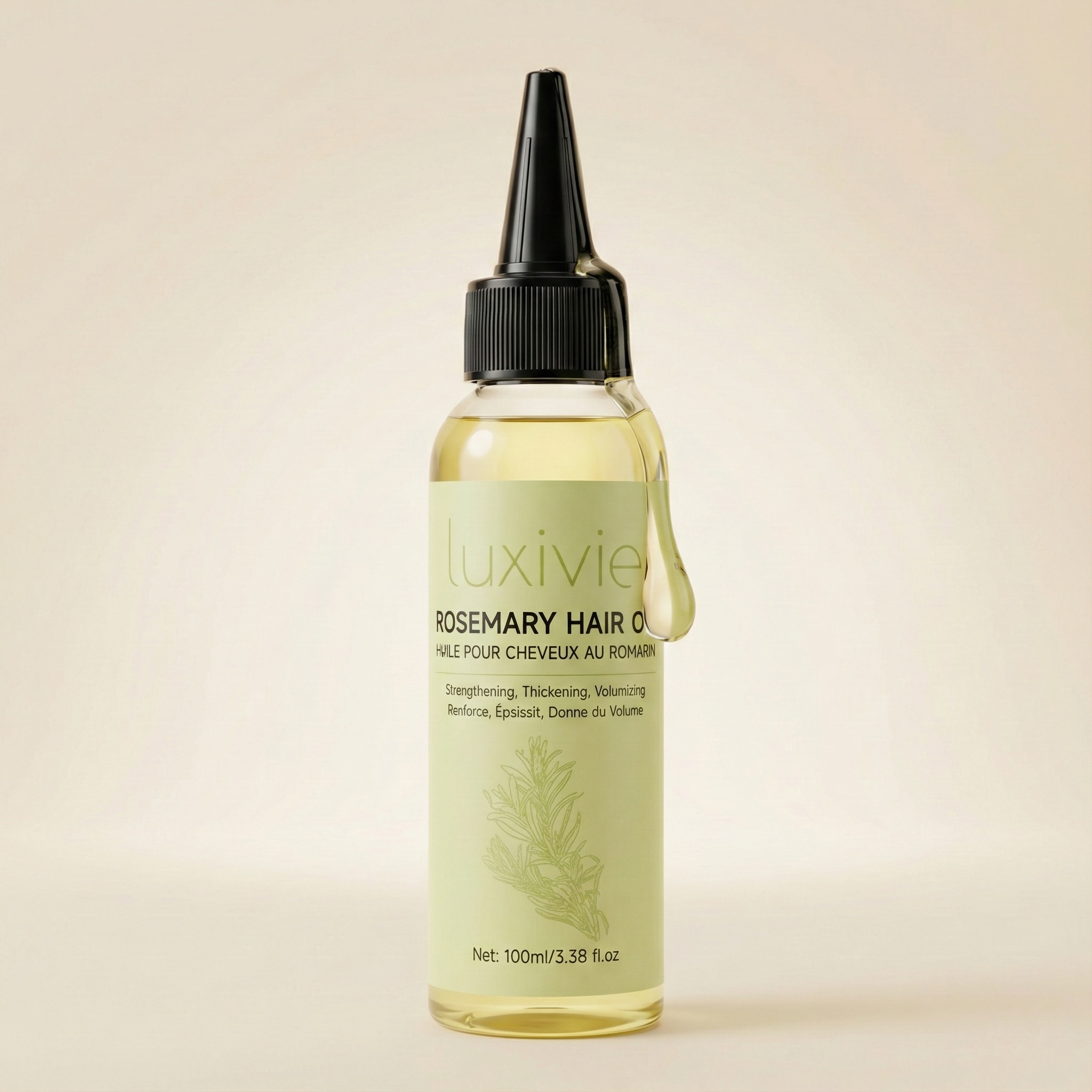
Luxivie Rosemary Hair Oil — Lightweight Oil for Fuller-Looking, Smoother Hair
Description: Give thinning-looking hair a smoother, more polished appearance. This lightweight rosemary hair oil helps add shine and softness while enhancing the look of fuller-looking hair. A simple finishing step for dry, dull or thinning-looking hair without a heavy, greasy feel.
Shop Now on Amazon.ca