How to Choose a Lightweight Conditioner for Oily Hair
If your roots look oily soon after washing, conditioner can feel like the step you are supposed to skip. You want hair that looks fresh and has some movement, so adding anything that might feel rich can seem counterproductive.
But the choice does not have to be between flat roots and rough ends. The useful question is whether your conditioner, the amount you use and the area you apply it to suit your hair.
A lightweight conditioner is one that gives you enough conditioning without an unwanted heavy finish. That is a result to look for, rather than a guarantee you can read from the product's colour, texture or one ingredient.
This guide focuses on rinse-out conditioner for oily hair. If your lengths are genuinely dry, they may need a different approach from your roots—and a different product from one designed specifically for oily hair.
First, separate your roots from your lengths
“Oily hair” can describe more than one situation. You may have roots that quickly look shiny while the rest of your hair feels comfortable. Or you may have oily roots with ends that feel rough, tangled or noticeably dry.
Those experiences should not lead to exactly the same routine.
Before shopping, answer three questions:
- Where does the unwanted heaviness appear? At the roots, through the lengths or mainly after styling?
- What do the ends need? Easier handling, a softer finish, or very little additional conditioning?
- When does the problem appear? Immediately after drying, after several finishing products or later between washes?
These observations will not diagnose a scalp condition, but they help you avoid blaming every heavy result on conditioner alone.
For a closer look at mixed needs, read how to balance oily roots and dry ends.
What does “lightweight” actually mean?
For your routine, a useful lightweight result might mean the lengths feel comfortable to handle, the ends do not feel coated and the style has the movement you prefer.
A watery-looking product is not automatically lighter in use than a creamy one. A clear conditioner is not automatically free of ingredients that can leave a conditioning film. Similarly, a thick texture does not tell you exactly how much product will remain after rinsing.
Look beyond appearance. The formula, your application amount, your hair and the rest of your routine all contribute to the result.
Also distinguish fine hair from oily hair. Fine hair describes the diameter of individual strands. Oiliness describes a different concern. Fine hair can be dry, and oily hair is not necessarily fine. A suitable purchase should account for both where relevant.
A practical shopping checklist
|
What to check |
Why it helps |
|
Intended hair type |
A conditioner clearly positioned for oily hair is a more relevant starting point than an unrelated rich treatment |
|
Product type |
Confirm whether it is rinse-out, leave-in or a mask; directions are not interchangeable |
|
Application directions |
Check placement, contact time and rinsing instructions before use |
|
Description of the finish |
Look for a clear cosmetic goal such as manageable hair rather than an unexplained promise to “balance” everything |
|
Full ingredient list |
Check ingredients relevant to your known sensitivities or preferences |
|
Realistic claims |
A conditioner should not have to promise reduced sebum production or scalp treatment to be useful |
|
Your existing routine |
Consider what you already layer on afterwards |
Do not judge suitability solely from “clean,” “natural” or “salon-inspired.” These descriptions do not tell you whether a conditioner will feel right on your hair.
Likewise, a free-from statement does not settle the question of weight. A product can meet an ingredient preference and still be too rich for the finish you want.
Should people with oily hair use conditioner?
Oily roots do not automatically mean the lengths need no conditioning. The relevant decision is where care is needed and how much gives you a comfortable result.
The American Academy of Dermatology recommends choosing hair care for your hair type and adjusting conditioner placement: ends-focused application may suit fine or straight hair, while dry or curly hair may need conditioning through more of its length.[1]
That guidance is not a reason to force the same product onto every hair type. A conditioner that works well for oily hair with modest conditioning needs may not provide enough care for very dry lengths.
If skipping conditioner leaves your ends difficult to manage, that is useful feedback. If applying it close to the roots leaves a finish you dislike, that is useful too. Adjust the routine in response to both observations.
How to apply a rinse-out conditioner thoughtfully
Use the product label as the starting point. Within those directions, the following approach makes your application easier to assess.
1. Start with a clear target area
Decide which part of the hair needs conditioning before dispensing the product. For someone with oily roots and otherwise comfortable hair, that may be primarily the ends. If your needs are different, choose a product and placement that reflect that.
Avoid massaging a lengths-and-ends conditioner into the scalp out of habit unless its directions explicitly call for that use.
2. Use an amount you can distribute evenly
There is no single coin-sized amount that suits every length, density and formula. Begin with the manufacturer's guidance rather than an arbitrary universal dose.
If you are changing the amount to improve your result, make one manageable adjustment at a time. Large changes make it harder to tell whether you have found a better balance or simply moved from too much to too little.
3. Follow the contact time
Leaving a rinse-out conditioner on longer is not automatically better. Use the instructions for the actual product. A quick daily conditioner and a treatment mask may have different directions.
4. Rinse as directed
Give rinsing your attention, especially where product tends to collect in your own routine. Do not intentionally leave in a rinse-out formula as a shortcut to making a leave-in.
5. Judge the dried result
The way hair feels in the shower is not your only measure. Notice the finish once you have dried and styled it as usual. Are the ends comfortable? Does the hair move the way you want? Is there a coated feeling you would prefer to reduce?
When your roots are oily but your ends are dry
This is where blanket advice becomes least helpful. Choosing a product simply because it says “for oily hair” may overlook the part of your hair that needs more conditioning.
Think in zones. Your cleansing needs and your ends' conditioning needs can differ. You may need targeted application, separate product choices or fewer styling layers at the roots.
Do not try to correct genuinely dry lengths by repeatedly adding more of a conditioner that is not intended for dry hair. If the fit is wrong, more product may not solve it.
Our guide to leave-in conditioner vs hair oil explains the different roles of two optional finishing steps. Neither should be used to excuse a wash routine that leaves your lengths uncomfortable.
If your overall hair is normal-to-dry rather than oily, understanding biotin and keratin in a hair routine may help you evaluate a different product category.
Troubleshooting a heavy or flat finish
Your hair looks heavy immediately after drying
Review the amount and application area. Then consider the rest of the routine: leave-in creams, oils, styling lotions and shine products may overlap. A conditioner can be blamed for the combined effect of several steps.
At the next wash, keep the core routine similar and remove one optional finishing layer. You are trying to understand the result, not to strip every conditioning step away at once.
The roots look oily later, but the ends feel comfortable
This does not automatically mean the conditioner is unsuitable. Consider how long it has been since washing and whether you applied products near the roots.
There is no need to force the same interval between washes for everyone. For more detail, read how often to wash fine, oily hair.
The lengths feel coated even when the roots look clean
Review repeated applications and styling-product overlap. If you suspect residue, product buildup vs an oily scalp can help you think through the distinction. A heavy feeling is a clue to examine the routine, not proof of one specific cause.
Your ends feel rough after reducing conditioner
You may have reduced more than those areas need. Restore appropriate care to the ends or reconsider whether the conditioner is the right fit. Fresh-looking roots do not require leaving the lengths uncomfortable.
You cannot tell which product is responsible
Keep a simple record of what you change. Note the amount, placement, finishing products and result after drying. A few comparable wash days are often more informative than changing the whole routine after every use.
How to compare two conditioners fairly
Choose products that are actually intended for your hair needs. Comparing an oily-hair conditioner with a rich treatment for very dry hair may tell you little beyond the fact that they serve different purposes.
Keep the rest of the routine reasonably consistent. Use each according to its own directions and assess the same outcomes: handling, softness at the ends, unwanted weight and your preferred finish.
You do not need a numerical score. Short notes such as “ends easy to manage, roots comfortable” or “lengths feel coated after styling” are enough to make the next decision more concrete.
Do not keep using a product that causes irritation just to complete a comparison. If you have persistent discomfort, pronounced flaking or a sudden change in the scalp, get individual professional advice rather than treating it as a routine lightweight-conditioner problem.
Where Luxivie Rosemary Mint fits
Luxivie Rosemary Mint Shampoo & Conditioner Set is intended specifically for oily hair and oily roots. The set contains one 500 mL shampoo and one 500 mL conditioner.
The conditioner is clear and transparent. That is a product characteristic, not proof that it will feel weightless on every head of hair. Your application and finished result still matter.
The relevant cosmetic goal is a fresh, clean feel and manageable hair. Rosemary and peppermint are part of the product positioning, but they should not be interpreted as a promise to treat a scalp condition or control oil production biologically.
This set is not recommended for dry hair. If your hair is normal-to-dry, Luxivie Biotin + Keratin Shampoo & Conditioner Set is the more relevant range option. If your needs are mixed, consider the dry areas carefully instead of assuming that an oily-root concern makes the entire set suitable for all your hair.
For dry-looking lengths and ends, Luxivie Rosemary Hair Oil is a separate finishing option. It is not an oily-scalp treatment, and sharing rosemary in the name does not make the products interchangeable.
Frequently asked questions
Does conditioner make the scalp produce more oil?
Do not equate a heavy-looking result with increased sebum production. Product placement and the overall finish can affect how oily the hair looks. This guide does not claim that conditioner changes the scalp's biological oil production.
Should I skip conditioner if my hair is oily?
Not automatically. Consider what your lengths need. If they become rough or difficult to manage without it, try an appropriate product and more targeted application rather than assuming all conditioning is unsuitable.
Is clear conditioner always lighter?
No. Transparency is an appearance characteristic, not a reliable measure of how the finished formula will feel after rinsing. Judge suitability from the intended use and your results.
Do I need a silicone-free conditioner?
That may be a personal preference, but it is not a universal requirement for oily hair. The presence or absence of one ingredient group cannot establish the weight of the entire formula. Check the current ingredient list rather than assuming a clear or botanical-looking product is silicone-free.
Can I use a conditioner for oily hair on dry ends?
Check the product's suitability. Some mixed-needs routines require separate choices. Luxivie Rosemary Mint is not recommended for dry hair, so do not treat it as the default solution for genuinely dry lengths.
Does a lightweight conditioner add volume?
It may help you achieve a finish you prefer if a previous routine felt too heavy, but “lightweight” does not guarantee extra volume. Styling, hair characteristics and the rest of the routine also matter.
What should I change first?
If your current product is appropriate for your hair, review placement and overlapping finishing products. If it is intended for a different hair need, start by choosing a better fit. The goal is fresh-looking roots and comfortable, manageable lengths—not the smallest possible amount of care.
Guide Sources
[1] American Academy of Dermatology, Tips for healthy hair. Supports hair-type-based selection and conditioner placement. Practical comparison exercises in this draft are editorial suggestions, not clinical protocols or product trials.
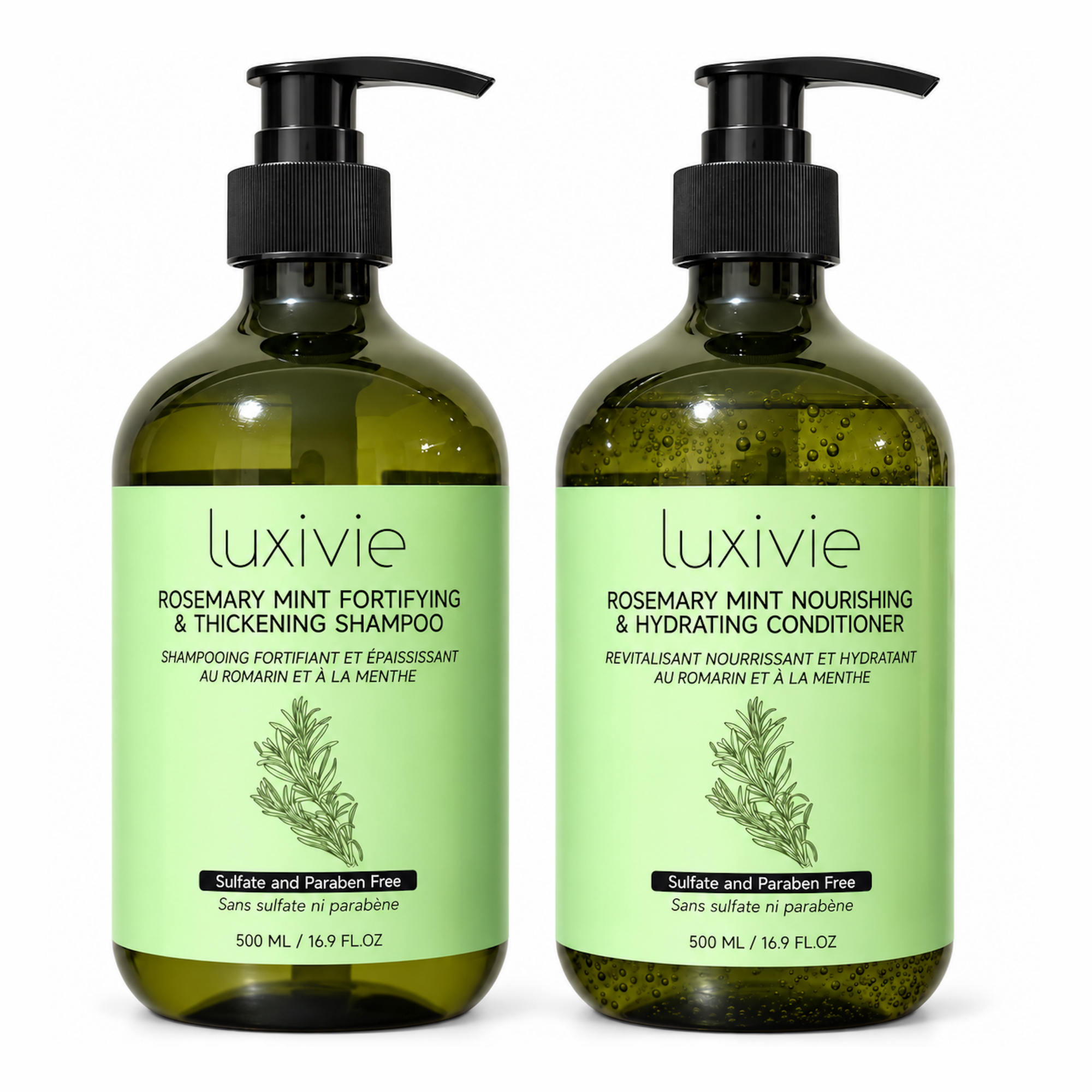
Luxivie Rosemary Mint Shampoo & Conditioner Set for Oily Hair — Gentle Cleansing & Lightweight Hydration
Refresh oily roots without weighing down your hair. This Rosemary Mint duo gently cleanses and refreshes while the lightweight conditioner softens and hydrates without leaving hair feeling heavy. Hair feels fresh, smooth and manageable, with a fuller-looking finish.
Shop Now on Amazon.ca