Biotin vs Keratin: What the Difference Means for Your Hair Routine
If your hair feels rough, looks dull or takes more effort to manage than you would like, biotin and keratin are two names you will probably encounter while shopping.
The packaging may make them sound like competing answers to the same problem. They are not the same ingredient, and the comparison becomes much clearer when you separate what they are from what a finished shampoo or conditioner can realistically do.
Biotin is a vitamin. Keratin is a structural protein found in hair. Neither ingredient name, on its own, tells you how a bottle of shampoo will perform.
For an everyday routine, the useful question is whether the complete formula suits your hair and helps deliver the feel, appearance and manageability you want. You do not need to become an ingredient expert before choosing your next wash routine.
Biotin and keratin at a glance
|
Question |
Biotin |
Keratin |
|
What is it? |
A B vitamin, also called vitamin B7 |
A protein associated with the structure of hair |
|
Where does confusion arise? |
Nutritional and supplement information is often mixed with shampoo claims |
Cosmetic conditioning is sometimes confused with permanent repair or salon straightening |
|
What does the name tell you on a hair-care label? |
That the formula is marketed with biotin; check the ingredient list |
That the formula is marketed with keratin; check its listed form |
|
Does the name prove hair growth? |
No |
No |
|
Does it predict the whole result? |
No; the full formula and use matter |
No; the full formula and use matter |
|
What should you assess? |
Suitability, cleansing or conditioning performance, and realistic claims |
Suitability, conditioning performance, and realistic claims |
This comparison is about choosing cosmetic hair care. It is not a recommendation to take a supplement or a way to diagnose a nutritional issue.
What is biotin?
Biotin is a nutrient involved in normal body functions, including the processing of nutrients from food. The US National Institutes of Health notes that evidence supporting common hair, skin and nail supplement claims is limited.[1]
That nutritional role does not establish that a shampoo containing biotin can increase hair growth. A rinse-off cosmetic is different from something you eat or take as a supplement. Evidence about one route of use cannot simply be transferred to another.
When shopping, keep these questions separate:
- What does biotin do as a nutrient?
- What evidence supports a particular topical product claim?
- Does the finished product suit the way my hair feels and behaves?
The first question does not automatically answer the other two. A biotin shampoo might be part of a routine you enjoy, but it should not be treated as a solution to hair loss merely because the vitamin is associated with hair in marketing.
What is keratin?
Keratin is part of the structure of hair. Hair-care formulas may use processed forms such as hydrolyzed keratin, which contains smaller protein fragments.
Researchers have studied how different keratin-derived peptides interact with hair fibres. One study on chemically relaxed hair found that molecular size affected penetration and measured outcomes.[2] That is useful context for why keratin is studied in cosmetic formulation. It does not prove that every keratin shampoo, conditioner or mask produces the same result.
The formula, the type of hair tested and the way a treatment is applied all matter. You cannot take a result from a laboratory treatment and assume it applies to a rinse-out product that has not undergone the same testing.
For routine shopping, focus on the supported cosmetic benefit: for example, a smoother feel or more manageable hair where the product's evidence supports that description. Be cautious about promises to rebuild hair permanently, reverse damage completely or make new hair grow.
Why the full formula matters more than the headline ingredient
A shampoo has a different main job from a conditioner. They also contain more than the one or two ingredients featured on the front label.
Imagine two products that both say “with keratin.” One may be a cleansing shampoo; the other may be a rich rinse-out mask. Even with an ingredient in common, their intended uses, application methods and finishes can be quite different.
The same applies to biotin. Its presence does not tell you whether a shampoo will feel light, whether a conditioner will be rich or whether the routine will suit oily roots.
Read the product description in this order:
- Hair suitability: Is it intended for oily, normal-to-dry or another clearly defined need?
- Product role: Is it a shampoo, rinse-out conditioner, leave-in, treatment or styling product?
- Directions: How is it intended to be used?
- Supported outcome: What should you reasonably expect to notice?
- Ingredients: Do the full list and any verified exclusions meet your preferences?
This order keeps the purchase connected to your actual routine instead of asking an ingredient name to do all the decision-making.
Which option makes sense for your hair concern?
Your hair is normal-to-dry and difficult to manage
Look for a wash routine intended for that hair condition, with conditioning that leaves the lengths comfortable to handle. Biotin, keratin or both may appear in the formula, but suitability comes first.
Describe the result you want in practical terms: less rough-feeling hair, easier styling or a softer finish. Those are more useful shopping goals than an undefined promise of “stronger hair.”
If you also want help deciding between post-wash products, read leave-in conditioner vs hair oil.
Your roots become oily quickly
A product being associated with strength or nourishment does not make it the right cleansing choice for oily hair. Start with the intended hair type and the finish you want at the roots.
For the conditioning step, see how to choose a lightweight conditioner for oily hair. You may need a different approach at the ends than at the roots.
Your hair is fine or looks flat
Fine hair describes strand thickness; it does not, by itself, tell you whether your hair is dry or oily. A routine can be appropriately conditioning and still need careful application to preserve the look you prefer.
Do not assume biotin will add density or that keratin always makes fine hair heavy. Those shortcuts overlook the complete formula, how much you use and where you apply it.
Your ends look dry but the rest of your hair feels comfortable
You may not need to replace your entire wash routine. A targeted finishing step could be the more practical experiment. Assess the actual ends rather than choosing a richer routine for the whole head automatically.
You are concerned about shedding or thinning
That is a different question from improving softness and manageability. Cosmetic ingredient comparisons cannot explain a change in hair density. If you notice persistent or sudden changes, seek individual advice from a qualified health professional rather than relying on a shampoo promise.
What “stronger-looking hair” should mean
“Stronger-looking” is a description of appearance. It should not be quietly turned into a claim that a formula changes the biology of the hair follicle or permanently restores the original structure of damaged strands.
For shoppers, it helps to translate broad wording into observable questions:
- Does my hair look more cared for after styling?
- Does it feel comfortable to handle?
- Do I like the smoothness and finish?
- Does the routine suit my scalp and lengths?
- Can I use it consistently without making the routine unnecessarily complicated?
If a brand claims a precise reduction in breakage or a measurable increase in fibre strength, look for evidence tied to that actual product and the conditions of the test. Ingredient research alone is not the same thing.
You do not need dramatic promises to justify choosing a product. A routine that makes ordinary wash days easier can be a worthwhile result.
How to build a simple routine for normal-to-dry hair
Begin with a shampoo and rinse-out conditioner intended for your hair needs. Use each according to its directions, including any specified contact time and rinsing instructions.
Then decide whether another step has a clear role. If your main concern is handling after washing, consider a suitable leave-in. If the hair feels manageable but the ends need a different finish, consider an appropriate oil instead.
Avoid introducing a shampoo, conditioner, mask, leave-in and oil simultaneously. Changing everything makes it difficult to identify what suits you. Start with the core wash routine and add only what answers a remaining need.
Keep your expectations specific. You are assessing cosmetic feel and appearance, not using your bathroom routine as a test of an ingredient's biological activity.
A simple note after a wash can help: “ends feel soft,” “too heavy near the roots,” or “easy to style.” This gives you a practical basis for adjusting the next use.
How to read claims without getting overwhelmed
“Contains biotin and keratin”
This describes named ingredients. It does not establish their concentration, the complete formula's performance or a particular result on your hair.
“Nourishing” or “healthy-looking”
These describe cosmetic positioning and appearance. They should not be read as promises to treat a medical condition or alter hair growth.
“Repair”
Ask what the brand means. A temporary improvement in appearance or a measured cosmetic effect is different from permanent restoration. The supporting evidence needs to match the exact wording.
“Vegan”
Do not infer this from the word keratin, or from a product being described as clean or botanical. Ingredient origin and the complete formula need verification. If that is important to you, look for a clear, current statement from the brand.
“Suitable for everyone”
Treat this cautiously when the product is otherwise positioned for a specific need. Oily hair and normal-to-dry hair can require different routines. A clear suitability statement is more helpful than an overly broad promise.
Where Luxivie's Biotin + Keratin set fits
Luxivie Biotin + Keratin Shampoo & Conditioner Set contains one 500 mL shampoo and one 500 mL conditioner. It is intended for normal-to-dry hair.
The relevant goal is a routine that supports nourished, manageable and healthy-looking hair. Choose it on that basis, rather than expecting the ingredient names to guarantee regrowth, permanent repair or a biological strengthening effect.
If your main concern is oily hair, Luxivie Rosemary Mint Shampoo & Conditioner Set is the range's oily-hair option. It is not recommended for dry hair.
If your main concern is the appearance of dry lengths and ends, Luxivie Rosemary Hair Oil is a separate finishing option for softness and shine. Sharing a brand name does not mean every product has the same purpose.
Common mistakes to avoid
Choosing from the front label alone. Read the intended hair type and directions before deciding that an ingredient trend matches your needs.
Expecting a rinse-out product to act like a supplement. Nutritional roles and cosmetic use are different. A shampoo is not a substitute for assessing a suspected deficiency.
Using softness as proof of permanent repair. A pleasing finish can be valuable without establishing a structural or medical claim.
Assuming more products containing the same ingredient will work better. A matching ingredient across several bottles is not a reason to use all of them. Give each step a practical purpose.
Continuing a routine that does not suit you because the ingredients sound impressive. Your experience with the finished formula matters. If the routine feels too heavy or leaves your lengths uncomfortable, revisit the fit.
Frequently asked questions
Is biotin better than keratin for hair?
There is no useful universal winner. They are different substances, and neither name is enough to select a finished product. Start with your hair concern, the product type and supported benefits.
Can biotin and keratin be used together?
They may appear together in a finished formula. That does not, by itself, prove an additional or synergistic benefit. Evaluate the product as a whole and follow its directions.
Will biotin shampoo make my hair grow?
Do not assume that from the ingredient name. A growth claim needs evidence for the actual product and use. This guide recommends cosmetic routines for feel, appearance and manageability, not growth treatments.
Is keratin shampoo the same as a salon keratin treatment?
No. A regular shampoo is not interchangeable with a professional smoothing or straightening service. The shared word does not establish the same formula, process, result or aftercare requirements.
Should I take biotin supplements for dry-looking hair?
Dry-looking hair alone is not a reason to self-diagnose a deficiency. Discuss supplement decisions with a qualified health professional. NIH also notes that supplemental biotin can interfere with some laboratory tests.[1]
Does my hair need keratin if it feels rough?
Roughness is not a reliable home test for a specific ingredient requirement. Review conditioning, suitability and styling habits. A familiar ingredient name should not replace that broader assessment.
What should I choose first?
Choose a shampoo and conditioner intended for your hair's current needs. Judge the routine on how it performs in ordinary use. Ingredient knowledge is useful when it helps that decision—not when it makes an everyday choice more confusing.
Guide Sources
[1] US National Institutes of Health, Office of Dietary Supplements, Biotin: Fact Sheet for Consumers. Supports the nutrient distinction, limited supplement evidence and laboratory-test caution. It does not evaluate Luxivie or topical biotin shampoo.
[2] Penetration of different molecular weight hydrolysed keratins into hair fibres and their effects on the physical properties of textured hair, International Journal of Cosmetic Science. Primary ingredient research; study-specific results cannot be attributed to Luxivie's formula. No study percentages have been used in the copy.
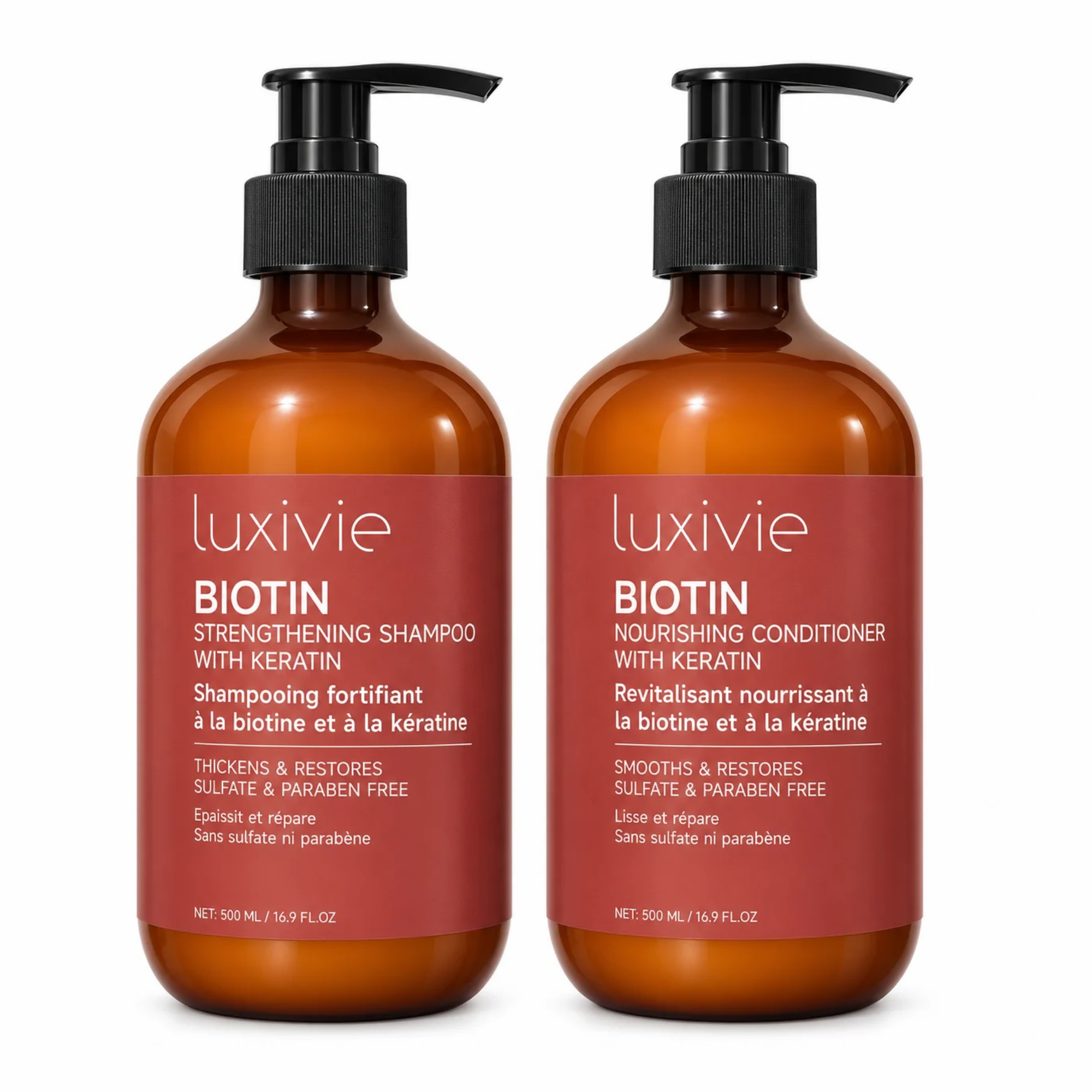
Luxivie Biotin & Keratin Shampoo & Conditioner Set for Dry & Damaged Hair — Strengthening & Smoothing Care
Care for dry, damaged-looking hair with a strengthening and smoothing duo. The shampoo gently cleanses while helping hair look fuller and more polished. The conditioner softens and smooths for easier detangling and improved manageability, leaving hair feeling soft and refreshed without weighing it down.
Shop Now on Amazon.ca